I have a friend who lives about 60km from Oświęcim (that's Auschwitz for all you non-Poles), so I actually heard about the week's big (Jew-related) story before it even appeared on BBC News. And I'll be honest...I did spend the next few hours, until the BBC realised, trying to verify the story, asking people if they had seen it. Turns out it's true, and it did happen. Now, one might expect that I will jump on the Jewish bandwagon here. To quote my friend: "Israel are pissed" - can you blame them, at this rate people will forget why they ever let us have the land back at all! Back to the point: apparently I have to be deeply offended that anybody would desecrate our...what, national monument? Anybody would think somebody came and took a piss on the Luchos haBris. I've got news for you, kiddos! Auschwitz is not, and never will be, a monument to the Jewish people. What do we need some sign up there reminding us that work will set us free...if by that we mean work will kill you, kind of the whole point of the place. I'm still waiting for the retractions when it turns out a few Jewish students stole it. "Sorry, we didn't think that arbeit macht frei, so we kind of...thought it would be a good statement...to take the lie down...yeah...we're not neo-Nazis". I think Jewcy almost hinted at that idea, but I know nobody is going to dare to blame anybody from the Jewish community. I don't mean to say the community is small out there in Poland (in part thanks to a good bit of arbeit, let's remember!), but if you blame the Jews, and you're not blaming that one, then you're blaming the other one, and he would have needed the first one to help him carry it away. Yeah.
Whilst we're at it, I'm really interested to know what use anybody could ever possibly have for that sign! I mean c'mon, think about it...it's a bit of a weird souvenir, is it hanging in somebody's living room now or what? Or maybe above somebody's front door, that would be an interesting way to enter a house, under the infamous sign. Either way, isn't it a bit strange for some Polish nationalist (apparently) to 'insult' the memory of the Holocaust victims when a few million Poles saw the ugly end of a rifle too? Let's be honest for a minute: not cool, Polish neo-Nazis, not cool at all.
Sunday, 20 December 2009


Tuesday, 1 December 2009
Switzerland.
You would have to have been living under a rock to have not already realised what this blog post might be about. For those of you who haven't figured it out yet, here's a clue.
Now, I'm going to take a leave from my normal family-friendly language with a quick message to 57,5% of the Swiss voters:
What.
The.
Fuck.
?!.
Although it is hardly a surprise to a lot of people (yeah, I admit that a lot of the news sites are calling this a 'surprise result', but they wouldn't claim anything else) that Europe has finally taken the step to display its racist, discriminatory tendencies on an officially-sanctioned, nationwide scale, I for one am still shocked and disgusted that it has actually happened. Not surprised, but I still didn't feel prepared for it. Let's just step back and take stock of what this means. This means that the people of Switzerland, a perfectly well-developed European country, have democratically voted yes to an effectively racist proposal. 57,5%, and, if we ignore the Muslims (who one could only assume would have put the effort in to go and vote 'no'), we might be talking about 60% of the white Swiss voters agreeing with this proposal. Another thing that we should remember is that this wasn't an attempt to introduce a new law, just one more on the list. No, this was a referendum to discuss changing the constitution of the country, to add in a line something like "no minarets shall be built in Switzerland". Once again, 60% of the white Swiss voters want to make Switzerland a constitutionally-racist country. A constitutionally-racist country.
Now, I admit that this referendum was in fact pointless, from a legal perspective. The people have voted yes to the proposal, yet this change in the constitution will never happen, of course. The Swiss High Court, or failing that an international body, will veto this referendum before it can be put into practice. So yes, a legally pointless referendum. Socially-speaking, though, this result couldn't have been much more important! As touched upon earlier, this is the tipping point. In a few decades, when historians look back, this date will no doubt be touted by many as the day it all started. The day anti-Islamism officially took hold in Europe. The day people across the continent began the slide back into the acceptable 'targeted racism' which has periodically blighted mankind for centuries. This result has sent out a message to all Europeans, Muslim or otherwise: it is okay to discriminate against Muslims. Follow the crowd, so to speak, and Switzerland have set a precedent now, for all Europeans to follow.
I'm too angry to say much more, so I'll give it a one-word summary: bugger.
Now, I'm going to take a leave from my normal family-friendly language with a quick message to 57,5% of the Swiss voters:
What.
The.
Fuck.
?!.
Although it is hardly a surprise to a lot of people (yeah, I admit that a lot of the news sites are calling this a 'surprise result', but they wouldn't claim anything else) that Europe has finally taken the step to display its racist, discriminatory tendencies on an officially-sanctioned, nationwide scale, I for one am still shocked and disgusted that it has actually happened. Not surprised, but I still didn't feel prepared for it. Let's just step back and take stock of what this means. This means that the people of Switzerland, a perfectly well-developed European country, have democratically voted yes to an effectively racist proposal. 57,5%, and, if we ignore the Muslims (who one could only assume would have put the effort in to go and vote 'no'), we might be talking about 60% of the white Swiss voters agreeing with this proposal. Another thing that we should remember is that this wasn't an attempt to introduce a new law, just one more on the list. No, this was a referendum to discuss changing the constitution of the country, to add in a line something like "no minarets shall be built in Switzerland". Once again, 60% of the white Swiss voters want to make Switzerland a constitutionally-racist country. A constitutionally-racist country.
Now, I admit that this referendum was in fact pointless, from a legal perspective. The people have voted yes to the proposal, yet this change in the constitution will never happen, of course. The Swiss High Court, or failing that an international body, will veto this referendum before it can be put into practice. So yes, a legally pointless referendum. Socially-speaking, though, this result couldn't have been much more important! As touched upon earlier, this is the tipping point. In a few decades, when historians look back, this date will no doubt be touted by many as the day it all started. The day anti-Islamism officially took hold in Europe. The day people across the continent began the slide back into the acceptable 'targeted racism' which has periodically blighted mankind for centuries. This result has sent out a message to all Europeans, Muslim or otherwise: it is okay to discriminate against Muslims. Follow the crowd, so to speak, and Switzerland have set a precedent now, for all Europeans to follow.
I'm too angry to say much more, so I'll give it a one-word summary: bugger.
Friday, 23 October 2009
Let's be unimaginative, then...
I was trying to put off writing anything about the Goldstone Report, because it's so obvious and everybody has already had their say on it. However, as I have nothing else to write about right now (and it has been a long time since my last entry, thanks to other commitments), so I thought I should write something, anything, and of course this is the biggest news right now. So, let's see what we can do:
First thing to say is that Mr Goldstone was right when he said that most of his critics haven't even read the report. I'm a critic, I haven't read the report, what's the big fuss? Fact of the matter is, from what I've heard, this report makes some pretty big statements. The kinds of statements that could land leading officials in the Israeli military and even central government in some painfully hot water, perhaps even a war crimes tribunal. It's time to wake up, people! War is war. And in war, people get hurt. People get killed. But the three week Israeli offensive in Gaza earlier this year wasn't even war. More accurately we could call it enforcement. It's difficult enough to conduct war in the 'legal' fashion (because of course imposing laws about how war can be fought makes it all the more acceptable) when there is a visible opponent, but what if the opponent is indistinguishable from the civilian population, fighting through guerilla tactics and terrorism, launching missiles with portable weapons, invariably placed in built-up areas, only a few metres from schools, hospitals and other civilian buildings? This, my friends, is dirty play. One of the dirtiest types of play, in fact. It leaves Israel with only two options. One is to do nothing, tolerate missiles with no retaliation and give up any control of what is technically-speaking sovereign territory. The other option is bombing the living daylights out of anything and everything, taking the risk that the missiles aimed at the terrorists may not hit their target directly, and instead cause damage to supposedly innocent people's property. Now would be a good time to point out that there is effectively no way of knowing who is innocent and who is colluding with the fighters, when nobody is in an organised national army. This explains why Netanyahu is talking about changing the laws of war.
Accusing Israel of committing war crimes, and crimes against humanity, is a serious enough allegation, but the report seems to be putting the blame firmly at Israel's door. As if it was an entirely unprovoked attack, and a totally disproportionate and cruel way of conducting business. Once again, nobody seems to be mentioning the fact that it is Hamas who pose the greatest threat to the common Palestinian. It is Hamas who brought the front line directly into Gazan settlements, rather than launching a more conventional military operation, even if that means the typical guerilla tactics of basing oneself in the forests, mountains or deserts. No, the new approach is to blend in amongst the innocent population, willing the larger, more powerful but, in all honesty, more liable bear, in this case Israel, to attack. Knowing full well that there is no way to attack without potentially committing some kind of war crime. It's a clever game that Hamas are playing, yet I am sure it isn't winning them too many supporters in Gaza, particularly not amongst those who have directly suffered as a result of their actions. Yes, yes, the international community should be concentrating its condemnation on the known terrorists, the rogue organisation, rather than the internationally-acknowledged nation, who are merely taking the bait, without much choice in the matter.
First thing to say is that Mr Goldstone was right when he said that most of his critics haven't even read the report. I'm a critic, I haven't read the report, what's the big fuss? Fact of the matter is, from what I've heard, this report makes some pretty big statements. The kinds of statements that could land leading officials in the Israeli military and even central government in some painfully hot water, perhaps even a war crimes tribunal. It's time to wake up, people! War is war. And in war, people get hurt. People get killed. But the three week Israeli offensive in Gaza earlier this year wasn't even war. More accurately we could call it enforcement. It's difficult enough to conduct war in the 'legal' fashion (because of course imposing laws about how war can be fought makes it all the more acceptable) when there is a visible opponent, but what if the opponent is indistinguishable from the civilian population, fighting through guerilla tactics and terrorism, launching missiles with portable weapons, invariably placed in built-up areas, only a few metres from schools, hospitals and other civilian buildings? This, my friends, is dirty play. One of the dirtiest types of play, in fact. It leaves Israel with only two options. One is to do nothing, tolerate missiles with no retaliation and give up any control of what is technically-speaking sovereign territory. The other option is bombing the living daylights out of anything and everything, taking the risk that the missiles aimed at the terrorists may not hit their target directly, and instead cause damage to supposedly innocent people's property. Now would be a good time to point out that there is effectively no way of knowing who is innocent and who is colluding with the fighters, when nobody is in an organised national army. This explains why Netanyahu is talking about changing the laws of war.
Accusing Israel of committing war crimes, and crimes against humanity, is a serious enough allegation, but the report seems to be putting the blame firmly at Israel's door. As if it was an entirely unprovoked attack, and a totally disproportionate and cruel way of conducting business. Once again, nobody seems to be mentioning the fact that it is Hamas who pose the greatest threat to the common Palestinian. It is Hamas who brought the front line directly into Gazan settlements, rather than launching a more conventional military operation, even if that means the typical guerilla tactics of basing oneself in the forests, mountains or deserts. No, the new approach is to blend in amongst the innocent population, willing the larger, more powerful but, in all honesty, more liable bear, in this case Israel, to attack. Knowing full well that there is no way to attack without potentially committing some kind of war crime. It's a clever game that Hamas are playing, yet I am sure it isn't winning them too many supporters in Gaza, particularly not amongst those who have directly suffered as a result of their actions. Yes, yes, the international community should be concentrating its condemnation on the known terrorists, the rogue organisation, rather than the internationally-acknowledged nation, who are merely taking the bait, without much choice in the matter.
Monday, 5 October 2009
And man can only do so much...
I have long been a sceptic of scientific 'fact'. In my opinion, it is too common for people to disprove these facts, as our knowledge increases, and as many as based on ever smaller, basic precepts, which could themselves be proven false at any time, it is difficult for me to trust that which scientists like to say as the indisputable fact that they like to claim.
One of the largest questions for me has always been global warming. I'm not here to deny global warming exists, or that we're doing anything about it, but I always ignore the predictions. If any of these were worth their salt, then they would agree. But, of course, they don't. Different groups constantly come out with new predictions for the next 10, 30, 50 years, all with different estimates for the temperature increase, the rise of the seas, any other question that one might have. These models, for instance, are not science. These models are guesswork, and believing any of them requires complete blind faith.
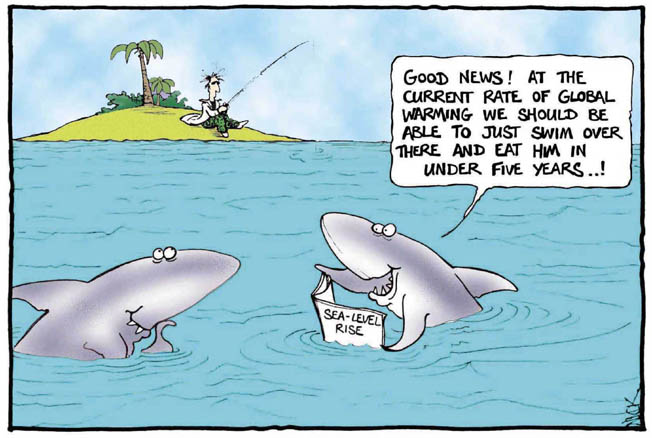 Now, we are told, global warming may have been totally misunderstood. Is this surprising, that global warming hasn't continued over the last decade, despite the fact that the human activities blamed for global warming haven't decreased,but increased? Is it really? Would we be surprised to discover that mankind, that most humble of creatures, couldn't fundamentally change the processes of an entire planetary system? The answer really should be no, we should be more surprised that burning a few lumps of coal could bring about an end to a structure which has, according to the studies, been functioning for the past 4,54 billion years! Of course there is a question of equilibrium, a potentially delicate balance between survival and complete destruction, but given the unfathomably powerful forces at work in and around our planet, as well as in and around the other celestial bodies, why would we believe that the balance is in our power? When we could never even dream of harnessing any force or power capable of overwhelming the immensity of the universe? I have even heard rumours that we might be helping...
Personally I'm going to suggest that we should just sit back and wait 50 years. And if we can still look back at what's happened, then we can safely say that the scientists were wrong. The global warming-Armageddon is probably a good few years off yet, no need to start fearing yet. And if the scientists are right, then it seems there's nothing we can do about it now, so let's just try to enjoy the weather.
One of the largest questions for me has always been global warming. I'm not here to deny global warming exists, or that we're doing anything about it, but I always ignore the predictions. If any of these were worth their salt, then they would agree. But, of course, they don't. Different groups constantly come out with new predictions for the next 10, 30, 50 years, all with different estimates for the temperature increase, the rise of the seas, any other question that one might have. These models, for instance, are not science. These models are guesswork, and believing any of them requires complete blind faith.
Now, we are told, global warming may have been totally misunderstood. Is this surprising, that global warming hasn't continued over the last decade, despite the fact that the human activities blamed for global warming haven't decreased,but increased? Is it really? Would we be surprised to discover that mankind, that most humble of creatures, couldn't fundamentally change the processes of an entire planetary system? The answer really should be no, we should be more surprised that burning a few lumps of coal could bring about an end to a structure which has, according to the studies, been functioning for the past 4,54 billion years! Of course there is a question of equilibrium, a potentially delicate balance between survival and complete destruction, but given the unfathomably powerful forces at work in and around our planet, as well as in and around the other celestial bodies, why would we believe that the balance is in our power? When we could never even dream of harnessing any force or power capable of overwhelming the immensity of the universe? I have even heard rumours that we might be helping...Personally I'm going to suggest that we should just sit back and wait 50 years. And if we can still look back at what's happened, then we can safely say that the scientists were wrong. The global warming-Armageddon is probably a good few years off yet, no need to start fearing yet. And if the scientists are right, then it seems there's nothing we can do about it now, so let's just try to enjoy the weather.
Thursday, 1 October 2009
How many sheep in the ark?
This may seem like a rather pointless question - how important is the number of sheep to the story of Noah's Ark? Does it change anything about it, does knowing the exact number add or subtract anything from the meaning of the story, prove or disprove its narrative? The answer, of course, is no, but it's a good first question for a fledgling Biblical scholar. Though I would like to think that I could maybe just about handle a slightly more complex and important question with regards to the scripture, why not just start here, because the fact that it's a simple question doesn't make it any less interesting (assuming you find Biblical comparison exercises interesting, that is!)
So, what would ever make me even consider such a question? It was a matter of weeks ago, in fact, when discussing the song 'Samson' by Regina Spektor. I was shocked to discover that many of the people I know don't actually know this story. Yes, shocked is the word, as I had always assumed that, along with Noah's Ark and the Exodus and a few other stories from here or there (mainly there, that is to say those later chapters Christians like to include), the story of Samson and Delilah was right up there with the Biblical stories even secular Christians know. And I was wrong. Either way, this all made me think of a particular episode of British TV show QI, the main bullet-point being: if you say Delilah didn't cut Samson's hair, everybody (or at least those who know the story!) will tell you you're wrong, but you're right, she didn't cut anybody's hair. And my mind linked this to another episode, and I believe the question was exactly the same as that above, 'how many sheep in the ark?'. The incorrect answer, of course, was two, and we were told that the correct answer was seven. The important verse for this is, no surprise, from the parshah of Noach:
So, what would ever make me even consider such a question? It was a matter of weeks ago, in fact, when discussing the song 'Samson' by Regina Spektor. I was shocked to discover that many of the people I know don't actually know this story. Yes, shocked is the word, as I had always assumed that, along with Noah's Ark and the Exodus and a few other stories from here or there (mainly there, that is to say those later chapters Christians like to include), the story of Samson and Delilah was right up there with the Biblical stories even secular Christians know. And I was wrong. Either way, this all made me think of a particular episode of British TV show QI, the main bullet-point being: if you say Delilah didn't cut Samson's hair, everybody (or at least those who know the story!) will tell you you're wrong, but you're right, she didn't cut anybody's hair. And my mind linked this to another episode, and I believe the question was exactly the same as that above, 'how many sheep in the ark?'. The incorrect answer, of course, was two, and we were told that the correct answer was seven. The important verse for this is, no surprise, from the parshah of Noach:
מכל ׀ הבהמה הטהורה תקח־לך שׁבעה שׁבעה אישׁ ואשׁתו ומן־הבהמה אשׁר לא טהרה הוא שׁנים אישׁ ואשׁתו׃Of every clean beast take unto you seven pairs, a male with its mate, and of the animal that is not clean, two, a male with its mate (Genesis 7:2)
I suppose the most logical thing to say here would be 'hmm!'. I won't pretend to be an expert mathematician, but even I know enough to know that a pair is two, so seven pairs would be 7 x 2 = 14. Which, it seems, isn't 7, so isn't the answer given in the programme. Could it be that the BBC would include this in their programme without even taking a Bible and checking their facts? This seems very unlikely...so maybe now I should explain the problem, and start talking about versions. The above Hebrew comes from the so-called Westminster Leningrad Codex, just because I copy-pasted it out of my Xiphos programme, and that's the particular Hebrew version I have installed there. The text, however, is identical to that found in any copy of the Tanakh you are likely to have, as it is the Masoretic text, the standard in world Jewry. The English translation beneath comes from my copy of the Tanakh, and as such translates the Hebrew quite accurately.
The researchers at the BBC, however, most likely don't have a Hebrew version of the scripture knocking about, nor the knowledge of Hebrew needed for that to be of any use whatsoever. Maybe, then, they reached for a copy of the King James Version:
Is this problem solely an English problem, though? Perhaps it appears in other languages too, for example, in the German-language Luther Bible:
Is it not possible that this ambiguity may be intentional? Although I am not entirely sure which texts the Luther Bible reflects in the Old Testament translation, I know that the KJV was, in fact, translated directly from the same Masoretic text that we know today. For the scholars, then, it must have been abundantly clear that there were fourteen sheep, so why would they write in such a way that somebody could believe there were only seven sheep?
The answer, strangely enough, may be found through Armenian. A strange side-road to take, I admit, but the Armenian translation of the Bible is over 1000 years older than the KJV and Luther Bible, having been initially translated in the early 5th century by Mesrop Mashtots, only a few centuries after the famous Latin Vulgate translation by Jerome of Stridonium. The Armenian text reads:
Why mention it, then? If my Armenian knowledge is lacking and my knowledge of the exact translation is little better? Solely for reasons of age, it being almost contemporary with the Latin Vulgate, which, for its part, tells the following:
An easy excuse for the similarity, particularly in absence of knowledge of which texts Mashtots used as reference, is that the Armenian translation, being slightly younger than the Vulgate, was translated directly from the Latin. This seems unlikely, as Armenia was very obviously in the sphere of influence of the Greek-speaking Eastern Roman Empire centred in Byzantium, rather than the Latin-speaking Western Roman Empire centred in Rome. In addition, it seems a lot more boring, and offers the possibility that Jerome made a mistake in translating, and was the first to suggest that there were only seven sheep. To me, that's just not enough fun, much better to go ever further back, in search of the text that both of these were translated from, which may also include a reference to only seven sheep.
Enter the Septuagint! For those of you somewhat unfamiliar with the terms, this is a Greek translation of the Tanakh used by Hellenised Jews living by the Mediterranean at a time when Greek was the lingua franca of the whole area. Consulting it shows us the offending line:
The Septuagint, however, is clearly incorrect in this respect, the Masoretic containing the true and original account, of fourteen of each type of clean animal, half (so seven, for those with poor maths / who haven't been paying ANY attention to the repeated references to the number seven all through this post!) male, the other half female. How can I say this with such certainty? Simple! Let us once again consult the Masoretic text. Rather than making you scroll back up again, I will just requote it here:
Like so many of the texts mentioned, the Masoretic clearly refers to the overall numbers using the same form, 'seven seven', or, in this case, 'שׁבעה שׁבעה'. Notice, however, that this isn't repeated in the second phrase. The Masoretic text lacks the 'two two', which was added to the Septuagint erroneously. The reason for this seems clear, that, in a Semitic language such as Hebrew, a form such as 'seven seven male and his female' would be understood as we now translate it, to mean seven males with one female each, such is the syntax of Hebrew.
This form, however, would be very confusing to somebody without a good knowledge of Hebrew, such as a Hellenised Jew. The Septuagint is known to contain many so-called 'Semiticisms', that is to say grammar and syntax which seems wholly logical to a Greek-speaking Jew, whose dialect may have been influenced by the Semitic substratum, yet would seem foreign or confusing to an indigenous Greek-speaker. The Jewish-American speech of today has a clear Yiddish substratum in grammar and syntax, following literal and direct translations of Yiddish phrases into English by Yiddish native-speakers. Even those today who cannot speak Yiddish maintain these peculiarities of speech, and the Greek-speaking Jews were no doubt no different. Returning to the point at hand: as knowledge of Hebrew waned among the population, it is possible to conceive that the 'seven seven' would imply seven animals in total, much like the modern English 'seven by seven' would mean. Therefore, perhaps some scribe through history 'corrected' the second phrase, by adding a 'two two', thus confusing later readers and translators, leading to the 7 / 14 discrepancy.
This 'seven seven' - 'two two' would then have been translated directly from the Greek into Latin and Armenian, keeping the same form, 'seven seven' - 'two two', most likely as the translators themselves were confused at the exact meaning! The same can be seen right up to the modern day, in, for instance, the Hungarian translation:
It is now time to complete the circle, and come back to the intentional ambiguity suggested for the English and German translations. Protestant translations of the Old Testament are known to have been predominantly based on the Masoretic text, whilst Catholicism has been far more keen on using the Septuagint, and translations based on that. It doesn't seem infeasible that the translators of the Protestant Bibles may have intentionally worded their translations ambiguously, so that they didn't categorically reject either the Vulgate, which had of course been the sole official source of Scripture in pre-Reformation Europe, or the more accurate Masoretic text. This in turn may explain why Hungary, for instance, a strongly Catholic country, maintained the previous wording, translated word-for-word from the Septuagint via the Vulgate, whilst the Protestant translations in Northern Europe leaned closer and closer to the authentic Masoretic account. The Swedish translations, in fact, are a perfect example of this. The Swedish Vasabibeln (1540-1) translation reads:
Irrespective, through some accident of history, there have come to be two competing traditions when it comes to this one single line. Each scholar is bound to take one side in the debate, some claiming that the Septuagint contains the older and more authentic account, which was later adapted and incorporated into the Masoretic text, whilst others, such as myself, claiming that the Masoretic is more authentic, with the Septuagint containing errors. Which account your own personal Bible agrees with, therefore, will depend a lot on which language it is in, so therefore the historical tradition of Biblical translations in that language, as well as the personal opinions of whichever scholars translated it, and the texts they chose to use in doing so. This need not necessarily refer solely to this one verse; there could be countless greater or smaller differences in meaning or suggested meaning between any two different translations of the Bible!
Maybe an interesting note to leave on, something else which could have prompted such a long (though equally exciting!) entry, is this: how could Noah, living in a pre-Sinai society, have known which animals were clean, and which weren't clean, if G-d hadn't told us yet? Good question, that, maybe I'll tell you the answer sometime...
The researchers at the BBC, however, most likely don't have a Hebrew version of the scripture knocking about, nor the knowledge of Hebrew needed for that to be of any use whatsoever. Maybe, then, they reached for a copy of the King James Version:
Of every clean beast thou shalt take to thee by sevens, the male and his female: and of beasts that are not clean by two, the male and his female.And so comes the problem. The English translation isn't particularly clear in this regard, whether it is intended that there were seven of each type of animal, or seven males, each with his female. To be honest, the fact that the first instance is in the plural, 'by sevens', whilst the second is in the singular, 'by two', suggests to me that these two are not grammatically identical, which would mean that there were not seven sheep in total, as in such a case the line would more likely read "of every clean beast thou shalt take to thee by seven, the male and his female", in keeping with the grammar in the next phrase.
Is this problem solely an English problem, though? Perhaps it appears in other languages too, for example, in the German-language Luther Bible:
Aus allerlei reinem Vieh nimm zu dir je sieben und sieben, das Männlein und sein Fräulein; von dem unreinen Vieh aber je ein Paar, das Männlein und sein Fräulein.Once again, the clean animals are taken 'seven and seven', which isn't particularly clear. However, the use of the word 'aus' at the beginning suggests to me that it is, once again, probably a total of fourteen. The different syntax in the second phrase, however, doesn't give the same opportunity for comparison as the KJV does.
Is it not possible that this ambiguity may be intentional? Although I am not entirely sure which texts the Luther Bible reflects in the Old Testament translation, I know that the KJV was, in fact, translated directly from the same Masoretic text that we know today. For the scholars, then, it must have been abundantly clear that there were fourteen sheep, so why would they write in such a way that somebody could believe there were only seven sheep?
The answer, strangely enough, may be found through Armenian. A strange side-road to take, I admit, but the Armenian translation of the Bible is over 1000 years older than the KJV and Luther Bible, having been initially translated in the early 5th century by Mesrop Mashtots, only a few centuries after the famous Latin Vulgate translation by Jerome of Stridonium. The Armenian text reads:
Անպիղծ բոլոր կենդանիներից եօթը-եօթը՝ արու եւ էգ, կը մտցնես քեզ հետ, իսկ պիղծ բոլոր կենդանիներից երկու-երկու՝ արու եւ էգI will make no attempt to claim expertise in the Armenian language, yet I do know that 'եօթը-եօթը', pronounced something like 'eot`a-eot`a' means 'seven-seven', whilst the 'երկու-երկու', pronounced something like 'erku-erku', means 'two-two'. Although I cannot guarantee that my attempts at transliterating the Armenian into the Latin alphabet have been 100% successful, the meaning is clear - the number seven refers to the clean animals in the same way that the number two refers to the unclean. Thus, the only way the Armenian Bible could be suggesting that there would be fourteen sheep would be if there were also four pigs, for example, or any other unclean animal. This we know to be false, therefore, the Armenian Bible agrees with the answer given on the QI programme, seven sheep. I will admit now to knowing no more about the origins of the Armenian Bible, and which texts it is known or supposed to have been translated from.
Why mention it, then? If my Armenian knowledge is lacking and my knowledge of the exact translation is little better? Solely for reasons of age, it being almost contemporary with the Latin Vulgate, which, for its part, tells the following:
ex omnibus animantibus mundis tolle septena septena masculum et feminam de animantibus vero non mundis duo duo masculum et feminamThe similarities to the Armenian text are striking, particularly the use of 'septena septena' and 'duo duo', of course the Latin for 'seven seven' and 'two two' respectively. As my Latin is significantly stronger than my Armenian, I can say with quite some certainty that the Latin Vulgate claims that there were only seven sheep on the ark. Why the discrepancy? Or, maybe an easier question, why the similarity between these two texts, and how does any of this link to the possibly-intentional ambiguity in the English and German translations?
An easy excuse for the similarity, particularly in absence of knowledge of which texts Mashtots used as reference, is that the Armenian translation, being slightly younger than the Vulgate, was translated directly from the Latin. This seems unlikely, as Armenia was very obviously in the sphere of influence of the Greek-speaking Eastern Roman Empire centred in Byzantium, rather than the Latin-speaking Western Roman Empire centred in Rome. In addition, it seems a lot more boring, and offers the possibility that Jerome made a mistake in translating, and was the first to suggest that there were only seven sheep. To me, that's just not enough fun, much better to go ever further back, in search of the text that both of these were translated from, which may also include a reference to only seven sheep.
Enter the Septuagint! For those of you somewhat unfamiliar with the terms, this is a Greek translation of the Tanakh used by Hellenised Jews living by the Mediterranean at a time when Greek was the lingua franca of the whole area. Consulting it shows us the offending line:
απο δε των κτηνων των καθαρων εισαγαγε προς σε επτα επτα αρσεν και θηλυ απο δε των κτηνων των μη καθαρων δυο δυο αρσεν και θηλυThe eagle-eyed amongst you will notice the exact same wording as in the Vulgate and Armenian translations, namely 'επτα επτα' ('epta epta', 'seven seven) and 'δυο δυο' ('duo duo', 'two two'). This is no accident! The Septuagint, too, teaches that the clean came in groups of seven, as the unclean came in groups of two. As we know that there were only two of each unclean animal in total, not two males and two females, we can deduct that there were only seven of each type of clean animal, in total, NOT, as the Masoretic text teaches us, seven males and seven females.
The Septuagint, however, is clearly incorrect in this respect, the Masoretic containing the true and original account, of fourteen of each type of clean animal, half (so seven, for those with poor maths / who haven't been paying ANY attention to the repeated references to the number seven all through this post!) male, the other half female. How can I say this with such certainty? Simple! Let us once again consult the Masoretic text. Rather than making you scroll back up again, I will just requote it here:
מכל ׀ הבהמה הטהורה תקח־לך שׁבעה שׁבעה אישׁ ואשׁתו ומן־הבהמה אשׁר לא טהרה הוא שׁנים אישׁ ואשׁתו׃
This form, however, would be very confusing to somebody without a good knowledge of Hebrew, such as a Hellenised Jew. The Septuagint is known to contain many so-called 'Semiticisms', that is to say grammar and syntax which seems wholly logical to a Greek-speaking Jew, whose dialect may have been influenced by the Semitic substratum, yet would seem foreign or confusing to an indigenous Greek-speaker. The Jewish-American speech of today has a clear Yiddish substratum in grammar and syntax, following literal and direct translations of Yiddish phrases into English by Yiddish native-speakers. Even those today who cannot speak Yiddish maintain these peculiarities of speech, and the Greek-speaking Jews were no doubt no different. Returning to the point at hand: as knowledge of Hebrew waned among the population, it is possible to conceive that the 'seven seven' would imply seven animals in total, much like the modern English 'seven by seven' would mean. Therefore, perhaps some scribe through history 'corrected' the second phrase, by adding a 'two two', thus confusing later readers and translators, leading to the 7 / 14 discrepancy.
This 'seven seven' - 'two two' would then have been translated directly from the Greek into Latin and Armenian, keeping the same form, 'seven seven' - 'two two', most likely as the translators themselves were confused at the exact meaning! The same can be seen right up to the modern day, in, for instance, the Hungarian translation:
Minden tiszta baromból hetet-hetet vígy be, hímet és nőstényét; azokból a barmokból pedig, a melyek nem tiszták, kettőt-kettőt, hímet és nőstényét.In all of these languages, Greek, Latin, Armenian, Hungarian and others, it seems likely that the phrase 'seven seven', 'two two' or any other such phrase originally had no meaning whatsoever. Perhaps later, due to their use in the Bible as direct translations of a direct Greek translation (and corruption) of an originally Semitic form, they began to be understood as a form in these languages, corresponding to the English 'seven by seven' and 'two by two', as in the song.
It is now time to complete the circle, and come back to the intentional ambiguity suggested for the English and German translations. Protestant translations of the Old Testament are known to have been predominantly based on the Masoretic text, whilst Catholicism has been far more keen on using the Septuagint, and translations based on that. It doesn't seem infeasible that the translators of the Protestant Bibles may have intentionally worded their translations ambiguously, so that they didn't categorically reject either the Vulgate, which had of course been the sole official source of Scripture in pre-Reformation Europe, or the more accurate Masoretic text. This in turn may explain why Hungary, for instance, a strongly Catholic country, maintained the previous wording, translated word-for-word from the Septuagint via the Vulgate, whilst the Protestant translations in Northern Europe leaned closer and closer to the authentic Masoretic account. The Swedish translations, in fact, are a perfect example of this. The Swedish Vasabibeln (1540-1) translation reads:
Af allahanda ren fänad tag til dig, ju sju och sju, mankön och qwinkön; men af orenom fänad, ju et par, mankön och qwinkön.This may be influenced by the ambiguous German Luther translation, using the same form 'seven and seven', yet in the Bibles currently in official use in Swedish Lutheran churches, the ambiguity is no longer present, and the verse refers explicitly to a grand total of fourteen of each clean animal:
Av alla rena fyrfotadjur skall du ta med dig sju par, hanne och hona, men av sådana fyrfotadjur som inte är rena ett par, hanne och honaCompare this to one of the most common modern English translations, the New King James Version, as used by Gideons International, amongst others:
You shall take with you seven each of every clean animal, a male and his female; two each of animals that are unclean, a male and his femaleHere, the ambiguity has also been eradicated, yet in the opposite direction of the Nordic translations, stating clearly that there were only seven sheep in total. As mentioned, I do not believe that the NKJV has translated what was actually written in the KJV particularly well, and many other contemporary English translations in use by other churches and organisations agree, writing explicitly that there were seven pairs.
Irrespective, through some accident of history, there have come to be two competing traditions when it comes to this one single line. Each scholar is bound to take one side in the debate, some claiming that the Septuagint contains the older and more authentic account, which was later adapted and incorporated into the Masoretic text, whilst others, such as myself, claiming that the Masoretic is more authentic, with the Septuagint containing errors. Which account your own personal Bible agrees with, therefore, will depend a lot on which language it is in, so therefore the historical tradition of Biblical translations in that language, as well as the personal opinions of whichever scholars translated it, and the texts they chose to use in doing so. This need not necessarily refer solely to this one verse; there could be countless greater or smaller differences in meaning or suggested meaning between any two different translations of the Bible!
Maybe an interesting note to leave on, something else which could have prompted such a long (though equally exciting!) entry, is this: how could Noah, living in a pre-Sinai society, have known which animals were clean, and which weren't clean, if G-d hadn't told us yet? Good question, that, maybe I'll tell you the answer sometime...
Tuesday, 29 September 2009
And they have rebelled against me
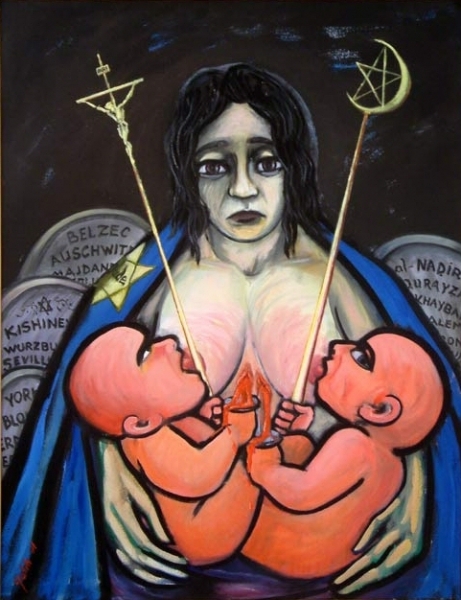 I saw the above painting, 'Judaism' by the Hungarian artist Moshe Galili, and it made me think. Particularly the accompanying verse from the prophecy of Isaiah:
שׁמעו שׁמים והאזיני ארץ כי י׳׳ה בו׳׳ה דבר בנים גדלתי ורוממתי והם פשׁעו בי׃
Hear, O heavens, and give ear, O earth: for the L-RD hath spoken, I have nourished and brought up children, and they have rebelled against me. (Isaiah 1:2)
How accurate, really, is this as a representation of the relationship between Judaism, Christianity and Islam? Have the spiritual 'children' of Judaism, that is to say the Christian and Islamic religions, really rebelled against their mother, Judaism? If so, this could be a very serious accusation, for it is written:
כי־יהיה לאישׁ בן סורר ומורה איננו שׁמע בקול אביו ובקול אמו ויסרו אתו ולא ישׁמע אליהם׃ ותפשׂו בו אביו ואמו והוציאו אתו אל־זקני עירו ואל־שׁער מקמו׃ ואמרו אל־זקני עירו בננו זה סורר ומרה איננו שׁמע בקלנו זולל וסבא׃ ורגמהו כל־אנשׁי עירו באבנים ומת ובערת הרע מקרבך וכל־ישׂראל ישׁמעו ויראו׃If a man have a stubborn and rebellious son, which will not obey the voice of his father, or the voice of his mother, and that, when they have chastened him, will not hearken unto them: then shall his father and his mother lay hold on him, and bring him out unto the elders of his city, and unto the gate of his place; and they shall say unto the elders of his city, This our son is stubborn and rebellious, he will not obey our voice; he is a glutton, and a drunkard. And all the men of his city shall stone him with stones, that he die: so shalt thou put evil away from among you; and all Israel shall hear, and fear. (Deut. 21:18-21)
The important issue here, though, is that no matter how rebellious the son may be, and no matter how disrespectful, aggressive or undesirable he is, a mother will, of course, never stop loving him. Women who have had children talk of this feeling, that even the most evil person, who may be hated by everybody else in the world, will still be able to rely on his mother to love him unconditionally. I myself have witnessed such inexplicable love myself.
And this is the role that Judaism must play. No matter how we feel that Christianity or Islam mistreats us, we must remember that they are, spiritually-speaking, our children. No matter how the effort may wear us down, we cannot give up! We may not agree with them in many aspects, we may be shocked and appalled at how they sometimes treat us, yet we have no choice - we must show our eternal motherly affection. Should a Christian or Muslim come to us for help, we must treat them as we would treat our own child, our own flesh and blood, and in doing so, may we help them feel ever closer to G-d, and may we help them regret, mourn and, eventually, atone for the sins that they or their forefathers may have committed against the Jewish nation. As close as we must keep ourselves, however, we must not let ourselves be influenced by that which makes them wayward, and we must maintain our position as the ever-doting mother, rather than the reckless son.
Monday, 28 September 2009
אַ דערמאָןל
קיצור־הדבר, ראָמאַן פּאָלאַנסקי האָט צו אַ קינד אַלקאָהאָל און נאַרקאָטיקן געגעבן, און ער האָט זי פֿאַרגוואַלדיקט. ער איז אַ אַנטלאָפֿןער פֿאַרברעכער, אַ פּאַסקודניק; פעדעפיליע איז אַ עקלדיק פֿאַרברעכן, גוואַלד געשריגן! האָבן אַלע דאָס פֿאַרגעסן?! דער הונט איז ווערט דעם שטעקן - זאָל ער מירצעשעם אין אַ תּפֿיסה זײַן
Subscribe to:
Posts (Atom)